Showing posts with label climbing. Show all posts

Thursday, November 5, 2009

Climbing Kilimanjaro: Part One

I think I need to tell this story in reverse, starting with the summit attempt and working backwards. It's like eating supper by starting with dessert; sometimes it's just better that way.

I should point out that there are many routes you can take to get up Mount Kilimanjaro so this account may be different than others. We chose the very challenging Machame route, a 67km, five day boot-camp for the summit attempt followed by a gruelling two day descent.

The route follows the "walk high, sleep low" principal of altitude training meaning that each day, climbers ascend to a higher altitude than they sleep at in the camps. This gives the body time to adjust to the extreme altitude and gives the climber the greatest possible chance for success.

Day five on the mountain began with a 5 to 6 hour trek from the Karanga Valley camp to the summit base camp, called Barafu. The camp is often under a blanket of snow and is always cold. Barafu means "ice" in Swahili.

After arriving at the camp, we spent some time re-organizing the gear in our packs, making sure we only had "the essentials" to minimize pack weight. We had a small bite to eat and hydrated the best we could on sore stomachs (courtesy of the altitude). Our guide told us to rest up as we'd be rising again at 11pm.

The wake-up call came quickly. It was cold. Very cold. We had a cup of tea and quietly gave the "good luck" nod or handshake to other climbers and friends we'd met along the way who were beginning their own migration up the steep slope.

Soon our turn came to set out from the dark camp. The pace was slow. Each step had to be chosen carefully in the light of our headlamps to keep from twisting an ankle or worse. One achingly slow step at a time, we were finally attempting the summit!

The ash/skree slope is a bit like walking in sand. That's difficult with a prosthetic limb due to the instability of the surface. I had to concentrate very hard on every step, making sure my footing was solid and not going to pitch or roll my body which would waste valuable energy in the recovery.

In this regard, my leg may have been an advantage. Having something to focus on occupied my mind and kept me from thinking about my lungs, the remaining distance or fatigue.

Around the 5000m mark we began passing other parties who were being forced to descend. Their attempt was over. Acute mountain sickness was a silent predator stalking the unlucky, not discriminating on age or fitness. None of us knew if it would strike us or if it did, when and how bad.

We passed by people doubled over in pain on the side of the track. Others were pleading with their guides to let them continue, though the sound of fluid in their lungs betrayed them. In some cases, mental or physical exhaustion had taken away the will to continue.

Groups of twelve, singing loudly at the start, were cut down to quiet groups of eight. Groups of eight were now groups of four. Whole teams were turning back. The further we climbed, the worse it got.

And then, sunrise.

The African sky cracked a tiny shard of red light on the horizon, warming us from the very soul. The glaciers to our left and below lit up like white beacons. We could see the top!

In that moment, we knew we were going to make it! With renewed hope, we leaned in and pushed to the top of Stella's point, the rim of the volcano. From there, it was a short 150m ascent to Uhuru Peak, the summit of Mount Kilimanjaro.

Arriving at the sign to take our victory photo was bitter sweet. We were reunited with friends we had made at the bottom of the mountain on the first day while we scanned new arrivals for the faces that were still missing.

It's difficult to describe the sheer emotion of reaching the top. Is it enough to say "we were pretty happy" and leave it at that?

Unfortunately our celebration had to be short lived. The increased risk of acute mountain sickness setting in at that altitude meant we had to begin our descent about twenty minutes after reaching the peak.

Physically and mentally exhausted, we now faced a four hour steep descent back down to Barafu camp to pack our gear, followed immediately by another six hour rocky descent to the Mweka base camp where we would finally get to sleep for the night.

Our goals shifted quickly. We had made it to the top, now we had to focus on getting down without getting injured.

On Machame, each day is more challenging than the last, including a near vertical "goat-track" climb up a sheer rock wall on day four. The climb down from the summit to our last base camp on day six was no exception.

By the time climbers attempt the summit from this route, they're physically and mentally prepared for the rigors of that very long, cold night. Just making it to the end of the each day felt like an accomplishment.

Wednesday, October 7, 2009

35 Days of Legadon

Today is the first day of Legadon. What is Legadon you ask? Allow me to explain!

The term "Legadon" (LegIsGone sounded too ghoulish) came about when I realized that I couldn't title this post "One Year Later" due to the fact that I have two big events to reflect on, 35 days apart. A single day just wouldn't do it justice which is the same reason I celebrate a "birthday week".

For me, the period between my accident (October 7th) and my last surgery (November 11th) has taken on a sort of "holy" symbolism, like Ramadan or Lent. As I understand it, those periods are meant to be a time of self-reflection, endurance and sacrifice resulting in a greater devotion to what's important in life.

Ramadan is approximately one lunar month long and Lent is a strict 40 days. Legadon is 35 days long.

During my first Legadon, I endured fear, intense pain and great sadness. I felt great joy and trepidation for the future. I learned humility and gained an appreciation for what's really important in life.

This Legadon, I will be experiencing much of the same as we continue our climb up Mount Kilimanjaro. With any luck, today we will climb to 15,000 feet (4,572 meters) and begin to experience the effects of extreme altitude before descending back down to 12,950 feet (3,947 meters).

Yep, nearly a year has passed but it still seems like yesterday. Life took an unexpected turn from normal that day and landed me in a very new situation, but in many ways, life has never been better.

Things got a bit more complex but if not for the events of that day, I would have missed out on meeting some very special people and reconnecting with friends and family.

A wise man said to me once: it's amazing how even in the most "unlucky" of moments you can feel really lucky. Well put.

One thing's for sure, if it wasn't for that day, I would have needed a different title for this blog. It would just be weird otherwise!


Note: This post was pre-written and pre-scheduled to be published before I left, so unfortunately I will be unable to respond to your comments at this time. I'll respond when I return!

Monday, October 5, 2009

The Shining Mountain

Wednesday marks the first anniversary of my accident.

To mark the occasion properly, this morning we began our seven day ascent up Mount Kilimanjaro, Tanzania, Africa, Earth, Orion Arm, Gould Belt, Milky Way Galaxy.

Kilimanjaro means "shining" or "glittering" mountain in Swahili and is one of the world's so-called "Seven Summits" of mountaineering, referring to the highest peak on each continent. The summit stands nearly 6km above the surface of the earth and its snowy peak is an equatorial anomaly.

We have chosen to take the Machame route as our guide up the mountain. The route takes 7 days but has a greater chance of success as there is more time to acclimatize to the extreme altitude. We travel with an experienced guide and a slammin' camera.

I've been told varying statistics of people who actually make it to the top ranging from 1 in 10 on the low end to 5 in 8 on the upper end. Some of the fittest people in the world are air-lifted off the mountain each day due to the effects of altitude sickness. It's impossible to predict based on age, sex or even physical condition.

I desperately want to make it to the top of course, but I'm keeping my expectations in check. It's about the journey and the experience, not the summit. This is about marking how far I've come from that hospital bed, not ending up in another one. I'll be making daily assessments of my condition and won't do anything to put us in jeopardy.

The plan, if all goes well, is to make our summit attempt on October 10th (day 6). We'll begin the strenuous 17 hour trek to 19,340 feet or 5,895 meters, starting out from the Barafu summit base camp just after midnight. The temperature should be around -23 degrees Celsius (-10 F) and we'll do the majority of the steep climb in the dark.

It will also be my first attempt to walk in snow on a prosthetic leg, but hey I'm Canadian, it's in my blood.

With me I have a list of names of every person who has helped me through this last year: my friends, my family, my support network, etc, right down to "Wally, the friendly dude who sold me my hiking boots". When the going gets really tough, I'm going to read that list to keep me going, assuming I'm not insane from oxygen deprivation.

I honestly don't know how we'll do, but I hope to have the courage to keep plodding along when things get really tough. I'm going to take it one step at a time, one foot in front of the other.

I'm prepared for whatever comes, but if they take me off this mountain, it won't be for lack of will, I can promise you that.


Note: This post was pre-written and pre-scheduled to be published, so unfortunately I will be unable to respond to your comments at this time. I'll respond when I return!

Thursday, August 6, 2009

Back to Climbing

We had a good time climbing on the weekend!

I bashed up my right knee and ankle with some nice bruises making a few less-than-graceful moves, however, it was nice not worrying about bashing up my left leg's mis-sized socket. It only has to last me two or three weeks afterall -- I wonder if the Kevlar in those layers makes it bullet-proof...

Here's a shot of our crew having a BBQ overlooking the city and river from the top of the cliffs. Made for a great way to spend a Sunday!

Saturday, April 18, 2009

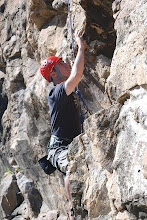
Climbing at Kangaroo Point

Four weeks ago, on March 19th, I set a goal for myself that I would do my first outdoor rockclimb in one month.

Today I achieved that goal with the help of some very good friends. It was great to be back on the rock and even better to make it to the top!

Climbing on the prosthesis was similar to what I'd expected it to be but I learned a lot that I hadn't expected. I've been visualizing the actions and trying to work out where my advantage points would be as well as what I'd need to overcome.

As MJ commented in an earlier post, imagine standing on a toe that never gets tired. This was great and it did provide a neat little perch when I could find a secure enough ledge to stand on.

Trouble was, the super flexible foot inside the shoe would also flex a little too much, twisting out of cracks when I didn't expect it, or twisting sideways off the tiny micro-edges of a sheer rock face without providing me the feedback that it was about to let go.

The foot itself is also a bit more narrow than a real foot, so putting my faith in the side of the climbing shoe was no longer an option.

I did like the fact that my toes didn't get sore in my left foot. This was fantastic when I was climbing a narrow crack. No big toe to start complaining!

A lot of my challenges today came down to a lack of sensation.

When you climb, you feel the rock through your feet a lot rather than looking for holds. A bit of pressure through the toes usually provides enough feedback to let you know whether you're going to stick or slip before transferring all of your weight to the hold.

This was definitely lacking on my left side, leaving me the challenge of working out a new system on the fly. More than once, I put my faith in a foot hold that proved to be a mistake. This new "spidey sense" will develop with more practice.

All in all, we had a great day and I had a good sense of accomplishment. I learned a LOT, found a few hitches that I'll have to work out, but eventually, I reached the top of the cliffs.
I'm happy to report that a lot of my mishaps on the cliff came less from prosthetic troubles and more from:
a) being out of practice
b) lacking proper climbing form
c) lacking confidence in my hands/shoes

... and all of that comes from not having climbed in six months. This is great news because I can easily overcome all of those by getting more practice in.

Looking forward to getting back out there for another try very soon! I've got a new form to work out so these are exciting times.


Lisa approaching the top!


Matt taking the hard road; this sheer face really shows his skill.


Mike and Mel, she's the best!


Monday, February 9, 2009

Climbing Mount Coolum

Being a new amputee isn't ALL great parking, fancy crutches and jaw dropping second looks at the mall, sometimes it can be a challenge too! I know that might be hard to believe so allow me to elaborate.

Take for example hiking or climbing a small mountain as was the case this weekend at Mount Coolum. I dare you to drive past that mountain without saying "we should climb that". It's just so damned tempting!

We pulled in and scouted the terrain. The sign at the bottom read "Experienced climbers only." CHECK! If that's the only stipulation, we should be fine. We've done hundreds of these hikes in our lives, all very successfully. Granted, most of those were completed bi-pedally but logically we should be able to assume that being a tri-ped can only help matters!

Now normally, one sign is enough for a guy like me, but I promised my Mom I'd be more careful. We looked around and sure enough, we found a second sign showing a man using a walking stick to make himself tri-pedal just like me. Clearly this is an advantage! His pack was much bigger than mine and he didn't even look tired! That was enough evidence for us, we started the long trek up an endless staircase to the trail head.

A hike like this would usually take us about 30 minutes and that's with ample photo time. A quick sprint to the top, plant the flag to covertly claim another small piece of this strange island for the great nation of Canada, a few quick snaps, a mouthful of orange vitamin water and a quick scree-ski to the base.

We must've been tired because it took us a lot longer than it used to. Could it be that we're getting out of shape? Perhaps we just needed more vitamin water... I knew we shouldn't have switched brands!

We hiked for about 45 minutes, deep into the "home of the peregrine falcon", or so another sign told us. The trail got steeper and much more rocky. We passed a sign that mentioned death or danger or... something... but we were so far off our normal pace, we didn't have time to read it. I'm sure it wasn't important but the little man with the walking stick was crossed out so I guess he didn't make it that high.

Not to worry, we didn't actually go beyond the giant unmistakable DANGER sign. I'm enjoying this period of challenge but I'm not so dumb as to do something that could risk my progress and my brilliant partner in crime is no fool either. She's a tough chick but I doubt very much that she's going to be able to piggy-back me down something like that.

Unfortunately we weren't able to make it to the summit on this attempt, a fact that still sits sour with me. We did get pretty high up but there came a point where we made the collective decision that the terrain was getting too treacherous to continue. Not too treacherous for going up, just for coming back down. There comes a point where crutches begin to high-center a person and the drops become a little too extreme when coming down a very steep slope.

Back at the base of the mountain for a little fishing, some salt and vinegar chips and a slug of orange vitamin water. This is the good life my friends, drink it up!

Monday, January 26, 2009

Indoor Climbing

We gathered up the old crew (minus one Smiffy) and went indoor climbing this past weekend. I wanted to work out some techniques in the safety of the gym before we try it outdoors.

I've been visualizing this for a few weeks now, trying to get my head around how to do it with one leg. The body mechanics of climbing are about using slow/strong/finesse movements, not jerky/hopping ones. Lucky for me, my technique was never all that great to begin with so starting over wasn't going to be a huge change!

Also handy was the fact that I signed the waivers and got my membership before the accident. When we came in to pay, the guy behind the counter took a long look and said "Guess you won't be climbing then huh", to which I cheerily replied, "you're damn right I am".

Matt and I devised a way to protect the end of my stump using some packing foam with cut-outs to give the bone tip some breathing space. The MacGraham Boney Knub Protector 6000 is patent pending. A bit of high density foam and some tubi-grip is all we needed.

The climbing went really well. I did seven climbs and didn't fall once all night. The climbs were some of the easiest ones in the gym but it felt good to be back in action, even if it was indoor. I had a few stares but assumed it was probably due to my amazing physique and dashing good looks!

I started out using far too much hopping and not enough strength. It didn't take long to get tired enough to start thinking about technique again. So here's what I learned...

A quick "how-to" on climbing with one leg:

- Keep your arms stretched above you at full reach. You can hang from outstretched arms all day. You're a hairless ape, get used to it -- that's why we have lats.

- Look for foot holds much more side-to-side than higher up. Don't do the giant hop to the next hold "up" as the motion may tear your hands free. Use a controlled "swing" to get the next one to the side, slightly higher than the one you're on.

- Turn your knee and foot inside to use the outer edge of the foot on the holds. This centers your weight and allows your knee some freedom to bend without putting you off balance.

- As your leg gets higher, keep the arms stretched out rather than bending the elbows. Allow your body to "tent" out from the wall a bit until you can straighten the leg and stand up high enough to reach the next set of hands.

- Abseiling down takes a lot more balance. Find your center and move the leg back and forth to keep you from barn-dooring.

- Remember, you're indoors, this isn't real climbing and your life isn't on the line: protect the stump at all costs.

This might sound strange, but I really want to enjoy this period of time between getting my new leg and losing my old one. It's a huge challenge and it comes with a lot of problem solving. I've been enjoying it in a perverse sort of way. Exploring the phantom sensation and discovering that the brain has more to do with pain than the body does has been fascinating!

UPDATE: Here's the video of my third climb. I was still trying to work out a technique so don't pay too much attention to form. I stayed on the blues to make it more challenging (harder than yellows) but I did far more (too many) big hops than I needed to. This burns out the leg and makes it difficult to go the distance.